


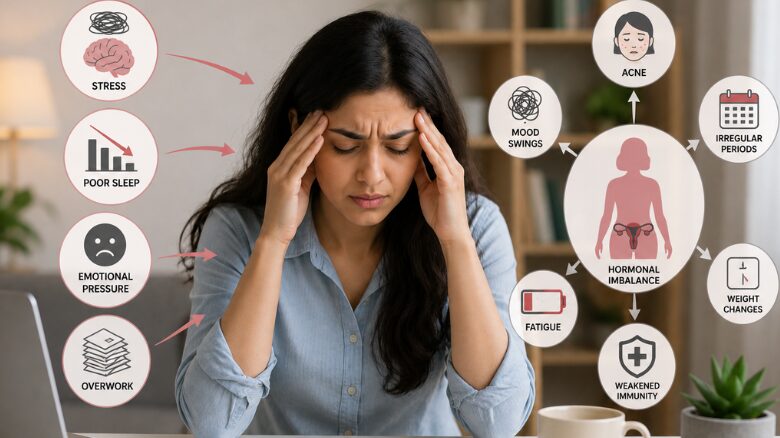
In India, 82% of working women report high stress levels, according to the Cigna 360 Well-Being Survey. A lot of that stress doesn't stay in your head. It shows up in your cycle, your sleep, and your energy.
If your period's gone unpredictable, your sleep is wrecked, and you can't shake the fatigue, you've probably wondered if stress is behind it. You're not imagining the connection.
Yes, chronic stress can cause hormonal imbalance in women. When stress lasts a long time, high cortisol irritates the entire brain, ovaries, and thyroid. That affects your cycle, fertility, mood, and metabolism. Below, you'll find exactly how that happens, the signs to watch for, and what actually helps.
Can Stress Cause Hormonal Imbalance in Women?
Yes. Long-term (chronic) stress raises cortisol, and high cortisol interferes with estrogen, progesterone, thyroid hormone, and insulin. Short-term stress doesn't cause lasting damage. Stress that sticks around for weeks or months throws your hormones off balance.
Cortisol is your body's main stress hormone. Your adrenal glands, small glands that sit above your kidneys, release cortisol when your brain senses a threat, real or perceived. In short bursts, this is healthy. Cortisol sharpens focus and gives you quick energy.
The problem starts when the stressor doesn't go away. A demanding job, a health scare, financial strain, or caregiving responsibilities can keep cortisol elevated for months. Your body wasn't built to run in emergency mode that long, and your hormones are the first system to show it.
How Does Stress Disrupt Your Hormones?
Stress disrupts hormones through the HPA axis, short for the hypothalamic-pituitary-adrenal axis. Think of it as a signaling chain between three parts of your body: your hypothalamus, your pituitary gland, and your adrenal glands. When this chain stays switched on too long, it pulls resources away from producing reproductive and thyroid hormones.
Here's the sequence, step by step:
- Your hypothalamus detects stress and releases corticotropin-releasing hormone (CRH), a chemical alarm signal.
- Your pituitary gland picks up that signal and releases adrenocorticotropic hormone (ACTH), which tells your adrenal glands to act.
- Your adrenal glands respond by releasing cortisol into your bloodstream.
- Cortisol stays high if the stress doesn't let up.
- High cortisol blocks gonadotropin-releasing hormone (GnRH), the hormone that normally tells your pituitary gland to release FSH and LH, two hormones that trigger ovulation and estrogen and progesterone production.
- Cortisol also acts separately on your thyroid and blood sugar systems, slowing thyroid hormone signaling and disrupting insulin, even though these run through different pathways than your reproductive hormones.
This chain, the HPA axis, drives nearly every symptom in this article. Once you understand it, the rest makes sense: your period, energy, mood, and metabolism all run through the same stress-response system.
What Are the Signs of Stress-Related Hormonal Imbalance?
The most common signs are irregular periods, fatigue, weight changes, sleep problems, and mood swings. Because stress touches multiple hormones at once, symptoms often show up in more than one system simultaneously.
Watch for:
- Delayed, missed, heavier, or lighter periods
- Increased menstrual cramping
- Persistent fatigue, even after rest
- Weight gain, especially around the abdomen
- Trouble falling or staying asleep
- Anxiety, irritability, or depressed mood
- Hair thinning or hair loss
- Dry skin or skin changes
- Difficulty concentrating
- Reduced sex drive
One or two of these on their own could mean a lot of things. But several together, especially alongside a stressful stretch in your life, point toward stress-driven hormonal imbalance. Three areas are worth a closer look: your cycle, your fertility, and, if you have it, your PCOS.
How Does Chronic Stress Affect Your Cycle, Fertility, and PCOS?
Chronic stress disrupts ovulation, which throws off your cycle and can make it harder to conceive. In women with polycystic ovary syndrome (PCOS), stress tends to make existing symptoms worse rather than cause new ones.
Your menstrual cycle
Elevated cortisol interferes with the signal your brain sends to your ovaries. That signal controls ovulation timing, so when it's disrupted, your cycle follows. You might notice delayed periods, missed periods, or bleeding that's heavier or lighter than usual.
This isn't just theory. A study of young Indian women found that those with higher perceived stress scores had menstrual irregularities far more often than their less-stressed peers (22% versus 4%), along with a much higher rate of heavy menstrual flow (72% versus 44%).
Fertility and ovulation
Stress can block the reproductive hormones needed for ovulation to happen on schedule. Since it interferes with FSH and LH, the hormones that trigger your ovaries to release an egg, ovulation can become delayed or unpredictable. This doesn't mean stress alone causes infertility. But if you're trying to conceive, unmanaged chronic stress makes it harder, on top of any other factors involved.
PCOS symptoms
If you have PCOS, chronic stress can make symptoms like irregular periods, acne, excess facial or body hair, and weight gain worse. The relationship also runs the other way: living with PCOS is itself stressful, which can create a cycle where each condition feeds the other. Managing stress won't cure PCOS, but it's a real part of managing it well alongside medical treatment.
Can Stress Affect Your Thyroid, Sleep, and Weight?
Yes. Cortisol competes with thyroid hormone production, disrupts sleep-regulating hormones, and encourages fat storage, particularly around your midsection. These three effects often show up together and reinforce each other.
Thyroid function
Your thyroid regulates metabolism and energy. Chronic stress can interfere with thyroid hormone production, leading to fatigue, weight changes, hair loss, dry skin, and trouble concentrating. Because these symptoms overlap heavily with stress itself, thyroid issues are easy to miss.
Sleep
High cortisol makes it harder to fall asleep and stay asleep. Poor sleep then raises cortisol further the next day. This cycle is one of the clearest, fastest-acting effects of chronic stress on your hormones. Aim for 7 to 9 hours a night to give your body room to reset.
Weight and metabolic health
Cortisol encourages your body to store fat, especially around your abdomen, while also increasing cravings for high-calorie food. Left unaddressed, stress-driven hormonal imbalance raises your longer-term risk for obesity, type 2 diabetes, high blood pressure, and cardiovascular disease. Long-term high cortisol can also lower bone density over time, which matters even more if your estrogen is already low, since estrogen helps protect your bones.
Is It Stress, or Something Else?
Stress symptoms usually ease once the stressor passes. If your symptoms persist regardless of how calm your life gets, PCOS, a thyroid condition, or perimenopause could be driving them instead.
This distinction matters because the overlap is significant. Irregular periods, fatigue, weight gain, and mood changes show up in stress, PCOS, thyroid disorders, and perimenopause alike. That overlap leads a lot of women to write off real hormonal conditions as "just stress" and put off getting checked.
A few signals worth paying attention to:
| Irregular periods | Often | Almost always | Sometimes | Often |
| Reduced sex drive | Often | Often | Sometimes | Almost always |
| Weight gain | Often | Almost always | Sometimes | Sometimes |
| Trouble sleeping | Often | Sometimes | Sometimes | Sometimes |
| Mood swings | Often | Sometimes | Sometimes | Sometimes |
| Hair loss | Sometimes | Sometimes | Often | Sometimes |
| Dry skin | Sometimes | Sometimes | Often | Sometimes |
| Trouble conceiving | Sometimes | Almost always | Sometimes | Almost always |
If your symptoms don't improve once your circumstances calm down, that's a sign to get evaluated rather than wait it out. Start with the lifestyle changes below. If they don't help within a few cycles, that's your cue to see a doctor.
How Can You Manage Stress and Support Hormonal Balance?
The most effective approach combines consistent sleep, regular movement, a balanced diet, and active stress-reduction habits like yoga, meditation, or deep breathing. Small, steady changes tend to work better than occasional, intense ones.
- Protect your sleep. Keep a consistent bedtime and aim for 7 to 9 hours nightly.
- Move regularly. Even a daily 20-minute walk lowers cortisol over time.
- Practice stress-reduction techniques. Yoga, meditation, and deep breathing all measurably reduce cortisol.
- Eat balanced meals. Prioritize whole foods and limit caffeine and alcohol, both of which can spike cortisol.
- Stay connected. Time with family and friends eases the physical toll of stress.
- Set boundaries with work and screens. Constant connectivity keeps your stress response switched on.
These habits won't reverse a diagnosed hormonal condition on their own, but they reduce how much stress adds to your symptoms, and they support whatever medical treatment you and your provider decide on.
When Should You See a Doctor, and What Will They Test For?
See a doctor if you have persistent irregular periods, ongoing fatigue, unexplained weight changes, difficulty conceiving, or stress that's interfering with daily life. A hormone evaluation typically starts with bloodwork and a conversation about your symptoms and history.
Reach out to a healthcare provider if you notice:
- Persistent irregular periods
- Difficulty conceiving
- Severe or ongoing mood changes
- Chronic fatigue that doesn't improve with rest
- Unexplained weight gain or weight loss
- Excessive hair loss
- Symptoms that suggest a thyroid disorder
- Chronic stress that's affecting your daily functioning
At your appointment, expect a discussion of your symptom history and possibly bloodwork covering cortisol, thyroid hormones (TSH, T3, T4), and estrogen and progesterone levels. At-home hormone tests exist, but they're best used as a starting point, not a diagnosis. A provider needs to interpret results alongside your full clinical picture.
Harsha Hospitals offers hormone evaluation and women's health checkups if you'd rather get a clear answer than guess.
Frequently Asked Questions
What are the 3 main stress hormones?
The three main stress hormones are cortisol, adrenaline (epinephrine), and norepinephrine. Cortisol manages your body's longer-term stress response, while adrenaline and norepinephrine drive the immediate "fight-or-flight" reaction, like a faster heartbeat and heightened alertness.
Which hormone causes stress and anxiety?
Cortisol is the hormone most closely linked to both stress and anxiety. When it stays high for too long, it can disrupt sleep, mood-regulating brain chemicals, and other hormones, which often makes anxiety worse.
Can stress cause low estrogen?
Yes. Chronic stress raises cortisol, which suppresses the hormone signal (GnRH) that triggers estrogen production in your ovaries. This can result in lower estrogen levels and symptoms like irregular periods and hot flashes.
What are some signs of low estrogen?
Common signs of low estrogen include irregular or missed periods, hot flashes, night sweats, vaginal dryness, mood changes, and trouble sleeping. Many of these overlap with stress symptoms, which is why an evaluation matters if they persist.
How can you boost estrogen naturally?
Regular exercise, a diet with enough healthy fats and phytoestrogen-containing foods like soy and flaxseed, adequate sleep, and stress management can all support healthy estrogen levels. These habits support your body's own hormone production, but they don't replace medical treatment for a diagnosed deficiency.
At what age does low estrogen typically start?
Estrogen naturally starts dropping in your late 30s to early 40s, during perimenopause, with a sharper drop around menopause, usually between ages 45 and 55. Chronic stress can lower estrogen at any age, though, separate from this natural timeline.
How do I check my estrogen levels at home?
At-home hormone test kits can measure estrogen through a blood spot or saliva sample, and they're a reasonable starting point if you're curious. But they shouldn't replace a clinical blood test interpreted by a doctor, especially if you're having persistent symptoms.
Does stress increase cortisol and cause weight gain?
Yes. High cortisol encourages your body to store fat, particularly around your abdomen, and increases cravings for high-calorie foods. Over time, this combination contributes to weight gain that's difficult to reverse through diet alone.
Can stress cause thyroid problems in women?
Chronic stress can interfere with thyroid hormone production and worsen symptoms like fatigue, weight changes, and hair loss. It doesn't directly cause conditions like Hashimoto's disease, but it can aggravate existing thyroid dysfunction.
How is stress-related hormonal imbalance different from PCOS?
Stress-related symptoms typically improve once the stressor resolves. PCOS symptoms, like irregular periods, acne, and excess hair growth, tend to persist regardless of your stress level and require medical management.
How can I balance my hormones naturally after a stressful period?
Prioritize consistent sleep, regular exercise, a balanced diet, and daily stress-reduction practices like meditation or deep breathing. Most women notice improvement within a few menstrual cycles, though persistent symptoms should be evaluated by a doctor.
What are 7 warning signs of stress affecting your hormones?
Watch for irregular periods, persistent fatigue, unexplained weight changes, sleep problems, mood swings, hair thinning, and reduced sex drive. Seeing several of these together, especially during a stressful stretch, points to a stress-related hormonal imbalance.
Key Takeaways
- Yes, chronic stress can cause hormonal imbalance. Sustained cortisol disrupts estrogen, progesterone, thyroid hormone, and insulin through the HPA axis.
- Watch for symptoms across multiple systems at once: irregular periods, fatigue, weight changes, sleep problems, and mood swings, especially during prolonged stressful periods.
- If symptoms persist once your stress eases, get evaluated. PCOS, thyroid conditions, and perimenopause can look like stress but need different treatment.
If your symptoms have lasted more than a few cycles or are affecting your daily life, don't wait to get checked. Harsha Hospitals offers comprehensive women's healthcare, including hormone evaluation, fertility support, and personalized treatment plans for every stage of life. Schedule a consultation with one of our gynecologists to get answers specific to you.