


|
Read Now
Getting your Trinity Audio player ready...
|
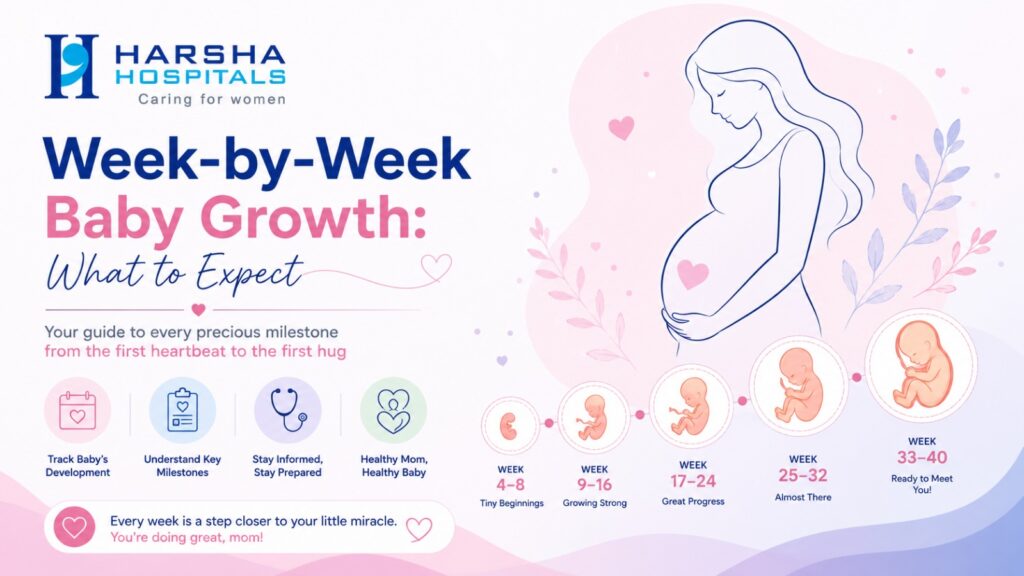
One of the most extraordinary parts of pregnancy is knowing that with every passing week, your baby is growing, changing, and becoming more complete. From a cluster of cells smaller than a grain of sand to a baby ready to meet the world, fetal development by week is nothing short of remarkable.
At Harsha Hospital, Kukatpally, we love helping mothers feel connected to what's happening inside them. This pregnancy week by week guide walks you through the key milestones of baby development during pregnancy — trimester by trimester — so you know exactly what's unfolding as your bump grows.
Fetal development varies naturally between pregnancies. Your doctor's scans and assessments are the most accurate guide to your baby's individual growth.
First Trimester: Weeks 1–12
The Foundation Is Being Built
The first trimester is when the most fundamental week by week baby growth takes place. Though your bump may not show yet, the changes happening inside are extraordinary.
Weeks 1–4: Conception and Implantation Life begins at fertilisation. Within days, the fertilised egg divides rapidly as it travels to the uterus and implants into its lining. By week 4, what will become your baby is a tiny ball of cells — but the foundations of the brain, spinal cord, and heart are already beginning to form.
Weeks 5–6: The Heartbeat Begins By week 5 or 6, a heartbeat can often be detected on an early ultrasound — a moment many parents never forget. The neural tube, which will develop into the brain and spinal cord, is forming. Tiny buds that will become arms and legs are appearing.
Weeks 7–8: Features Take Shape Your baby is now about the size of a kidney bean but growing fast. Facial features — including eyes, nostrils, and a tiny mouth — are beginning to form. Fingers and toes are emerging, and all major organs have started developing.
Weeks 9–12: Movement and Reflexes Begin By the end of the first trimester, your baby has all essential organs in place and is officially called a fetus. Fingers and toes are fully separated, tiny nails are forming, and your baby is beginning to make small spontaneous movements — though you won't feel them yet. At 12 weeks, your baby is around 5–6 cm long.
Second Trimester: Weeks 13–27
Growing Fast and Coming to Life
The second trimester is a period of rapid growth and exciting firsts. For many mothers, it's also the most comfortable stage of pregnancy.
Weeks 13–16: Bones, Expressions, and Sex Your baby's skeleton is hardening from cartilage to bone. Facial muscles are developing, allowing tiny expressions. By around week 16, the sex of your baby may be visible on an ultrasound scan.
Weeks 17–20: You Feel the First Movements This is often the most eagerly awaited milestone — the first flutter of your baby's movements, called quickening, usually felt between weeks 18 and 22. Your baby is now swallowing, developing taste buds, and can hear sounds from outside the womb. Lanugo — a fine covering of hair — coats the skin for warmth.
Weeks 21–24: Viability and Senses Your baby is now considered potentially viable outside the womb with specialist care, though every additional week matters enormously. Eyebrows and eyelashes are appearing. The lungs are developing rapidly, and your baby is practising breathing movements using amniotic fluid. Fingerprints are forming — unique to your baby alone.
Weeks 25–27: Fat, Brain, and Reflexes Your baby is building the fat layers that will regulate temperature after birth. The brain is growing rapidly, and your baby responds to light, touch, and familiar sounds — including your voice. A blink reflex is developing, and sleep-wake cycles are emerging.
Third Trimester: Weeks 28–40
Preparing for the World
The final trimester is about maturing, growing stronger, and getting into position for birth.
Weeks 28–32: Brain Development and Position Your baby's brain is developing at a remarkable pace, with billions of neurons forming connections. The eyes can now open and close. Most babies turn head-down during this period in preparation for birth. Your baby's movements may feel stronger and more distinct.
Weeks 33–36: Lungs Mature and Weight Increases The lungs are nearly fully developed by week 36 — a crucial milestone for life outside the womb. Your baby is gaining weight steadily, filling out with fat, and their skin is becoming smoother. Most of the lanugo hair is shedding, and head hair may now be visible on a scan.
Weeks 37–40: Full Term and Ready Your baby is considered full term from week 37. In these final weeks, they are putting on finishing weight, their immune system is receiving vital antibodies from you, and their head is typically engaged low in the pelvis ready for birth. By week 40, the average baby weighs around 3–3.5 kg and is fully ready to meet you.
The Role of Antenatal Scans
Scans are your window into your baby's fetal development by week. Key scans typically include an early dating scan in the first trimester, a detailed anomaly scan around weeks 18–20 to check all structures and growth, and third-trimester growth scans to track size and position. Your doctor may recommend additional scans depending on your pregnancy.
Why Choose Harsha Hospital for Pregnancy Care in Hyderabad
Families across Kukatpally and Hyderabad trust Harsha Hospital because it offers:
● Detailed antenatal scans and fetal monitoring to track your baby's development
● Complete maternity care from early pregnancy through delivery and beyond
● Dedicated high-risk pregnancy support under one roof
● A trusted name in Kukatpally, caring for women's health since 2007
● Compassionate, family-centred care at every stage of your pregnancy journey
Frequently Asked Questions
When does the baby's heartbeat start?
A heartbeat can often be detected on an ultrasound as early as week 5 or 6 of pregnancy.
When will I feel my baby move?
Most first-time mothers feel movement (quickening) between weeks 18 and 22. It may be felt earlier in subsequent pregnancies.
When is the baby considered full term?
From week 37, a baby is considered full term. Most healthy babies are born between weeks 37 and 42.
What happens at the 20-week anomaly scan?
This detailed ultrasound checks your baby's growth, anatomy, and development, and looks at the position of the placenta. It is one of the most important scans in pregnancy.
When do babies develop their senses in the womb? Hearing develops from around weeks 18–20, taste buds form around week 13–15, and the sense of touch is present from early in the second trimester. By the third trimester, babies can respond to light and recognise familiar voices.
Book Your Antenatal Scan at Harsha Hospital
Every scan is a chance to see your baby grow. Let our experienced maternity team guide you through each stage of your pregnancy with expert care and warm support.
Harsha Hospital — Plot No. 141 & 144/1, Ayyappa Swamy Temple Road, Sapthagiri Colony, Kukatpally, Hyderabad – 500072 Phone: 040 23066393 | Email: info@harshahospitals.co.in
Medical Disclaimer: This article is for general information and awareness only. Fetal development varies naturally between pregnancies. Please consult your gynaecologist or obstetrician for guidance specific to your pregnancy and baby's growth.