


|
Read Now
Getting your Trinity Audio player ready...
|
Many women only visit a gynaecologist when something is wrong. But the most powerful role a gynaecologist plays is often in prevention — catching changes before they become problems, and keeping you informed and in control of your own health.
Gynecological screenings are routine checks designed to detect early signs of conditions that may have no symptoms at all in their early stages. Done regularly, they are one of the most effective things any woman can do for her long-term health. At Harsha Hospital, Kukatpally, we provide complete preventive gynecology and women's health screening in a caring, confidential environment — because your health should never wait for a crisis.
What Are Gynecological Screenings?
Gynecological screenings are a set of examinations, tests, and conversations between you and your gynaecologist aimed at assessing and protecting your reproductive and overall health. They are not only for women with symptoms or those who are pregnant — they are for every woman, at every stage of life.
The importance of gynecological checkups lies in their ability to catch conditions such as cervical abnormalities, infections, hormonal imbalances, and benign or potentially concerning changes in the uterus, ovaries, and breasts — often long before they would cause any noticeable problem.
Key Screenings Every Woman Should Know About
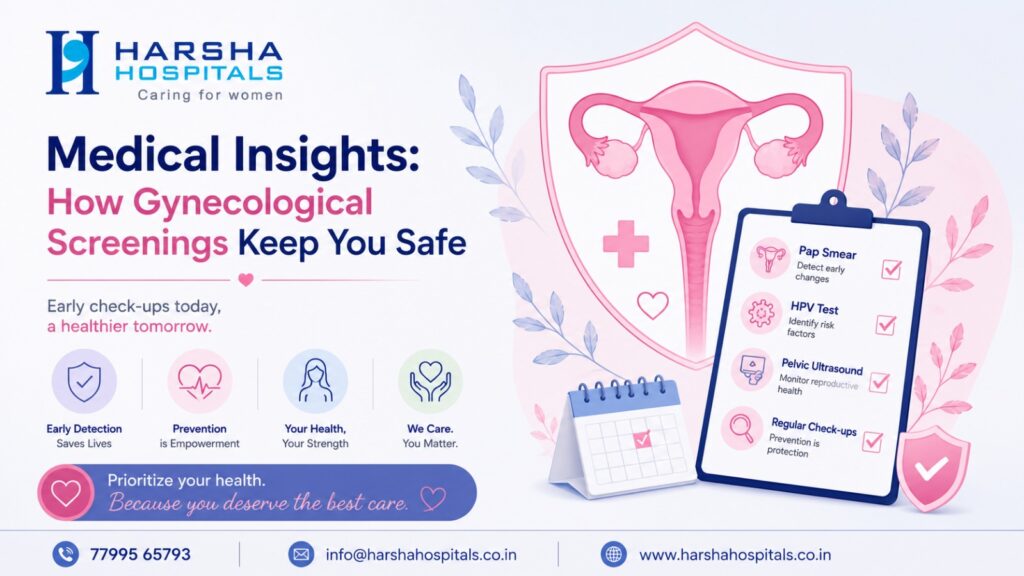
1. Pap Smear (Cervical Screening)
The Pap smear is one of the most important tests in women's health. It involves collecting a small sample of cells from the cervix to check for abnormal changes that could, if left undetected, progress to cervical cancer. The critical point is that most cervical abnormalities are completely treatable when found early — and a Pap smear is how they are found.
Women are generally advised to begin Pap smears from around age 21, or as recommended by their doctor, and to repeat them at regular intervals. Your gynaecologist will advise the right schedule for your age and history.
2. HPV Testing
Human papillomavirus (HPV) is a very common infection linked to the development of cervical cancer. HPV testing — sometimes done alongside or instead of a Pap smear — checks for the presence of high-risk HPV strains. Together, Pap smear and HPV co-testing give a clearer picture of cervical health than either test alone.
3. Pelvic Examination
A pelvic examination allows your doctor to assess the health of the uterus, ovaries, fallopian tubes, and surrounding structures. It can help detect fibroids, ovarian cysts, signs of infection, and other conditions. It is a routine part of a gynecological checkup and an important one, even when you feel completely well.
4. Breast Examination
Clinical breast examination — carried out by your doctor as part of a women's health visit — checks for any lumps, changes in texture, or other abnormalities. Women should also be familiar with how their own breasts look and feel at different times of the month, and report any changes to their doctor promptly.
5. Ultrasound of the Pelvis
A pelvic ultrasound is a non-invasive scan that gives your doctor a detailed view of the uterus and ovaries. It is used to investigate irregular periods, pelvic pain, or suspected fibroids, cysts, or other conditions — and is also often part of routine gynaecological assessment.
6. Blood Tests and Hormonal Screening
Blood tests can reveal a great deal about your reproductive health. Hormonal profiles help evaluate conditions such as polycystic ovary syndrome (PCOS), thyroid disorders, and perimenopause. Anaemia, blood sugar, and other markers are also checked where relevant. These tests are a key part of preventive gynecology at every age.
7. STI Screening
Screening for sexually transmitted infections (STIs) is an important and entirely confidential part of women's health care. Many STIs have no symptoms but can affect fertility and overall health if untreated. Open, non-judgmental STI screening is available at Harsha Hospital.
8. Bone Density Assessment
As women approach perimenopause and beyond, declining oestrogen levels can affect bone density. Bone health screening helps identify the early stages of bone loss (osteoporosis) so that lifestyle changes and treatment can begin early.
How Often Should You Have Gynecological Checkups?
Screening frequency depends on your age, health history, and risk factors. As a general guide:
Life Stage Key Screenings to Discuss with Your Doctor
Teens and early 20s General health, menstrual health, HPV vaccination
20s and 30s Pap smear, pelvic exam, breast exam, STI screening, hormonal health
30s and 40s All of the above, plus PCOS, thyroid, fertility, and preconception care
40s and 50s Pap smear, breast exam, hormonal screening, perimenopausal care
50s and beyond Bone density, breast health, postmenopausal care
The most important step is to have a conversation with your gynaecologist about what is right for you personally — your individual history, family history, and lifestyle all matter.
Warning Signs That Mean You Shouldn't Wait for a Scheduled Check
While regular screenings are about prevention, some symptoms should prompt a prompt visit regardless of when your last check was:
● Irregular, heavy, or painful periods that are new or worsening
● Unusual vaginal discharge or odour
● Bleeding between periods or after menopause
● Persistent pelvic pain or pressure
● A lump or change in the breast
● Difficulty conceiving after trying for a year (or six months if over 35)
These are not reasons to worry — they are reasons to get checked. Early attention almost always leads to better outcomes.
Overcoming the Barriers to Getting Screened
Many women delay gynecological screenings because of embarrassment, fear, cultural hesitation, or simply not knowing where to start. It's worth saying clearly: there is nothing to be ashamed of, screenings are confidential, and the discomfort of an examination is brief and manageable. The far greater risk is missing something that could have been found and treated early.
At Harsha Hospital, our team creates a safe, respectful, and judgement-free space for every woman.
Why Choose Harsha Hospital for Women's Health Screening in Hyderabad
Families across Kukatpally and Hyderabad trust Harsha Hospital because it offers:
● Complete gynecological screening and preventive women's health care under one roof
● Confidential, respectful consultations in a welcoming environment
● Expert gynaecologists with experience across all stages of women's life
● A trusted name in Kukatpally, caring for women's health since 2007
● Affordable, advanced care focused on early detection and long-term well-being
Frequently Asked Questions
What is included in a gynecological screening?
A typical screening may include a pelvic examination, Pap smear, HPV testing, breast examination, pelvic ultrasound, blood tests, and a discussion of your overall health and any concerns.
At what age should I start gynecological checkups?
Most doctors recommend beginning gynecological checkups in the late teens or early 20s, or earlier if there are specific concerns such as menstrual problems. Your doctor will advise what's right for you.
Is a Pap smear painful?
Most women find a Pap smear mildly uncomfortable rather than painful. It is brief, and the benefit — early detection of cervical changes — far outweighs any temporary discomfort.
How often should I have a Pap smear?
Recommendations vary by age and history, but most guidelines suggest every 3 years from around age 21, or every 5 years with combined HPV testing. Your gynaecologist will recommend the right interval for you.
What is Preventive Gynecology?
Preventive gynecology means regular screenings and checkups aimed at detecting problems before symptoms develop, so they can be treated early and health can be maintained at every stage of life.
Book Your Women's Health Screening at Harsha Hospital
Your health is worth prioritising — not just when something is wrong, but every year, at every stage. Let our expert team support you with caring, confidential, and complete gynecological care.
Harsha Hospital — Plot No. 141 & 144/1, Ayyappa Swamy Temple Road, Sapthagiri Colony, Kukatpally, Hyderabad – 500072 Phone: 040 23066393 | Email: info@harshahospitals.co.in
Medical Disclaimer: This article is for general information and awareness only and is not a substitute for professional medical advice. Screening recommendations vary by individual health history. Please consult a qualified gynaecologist for guidance specific to your situation.